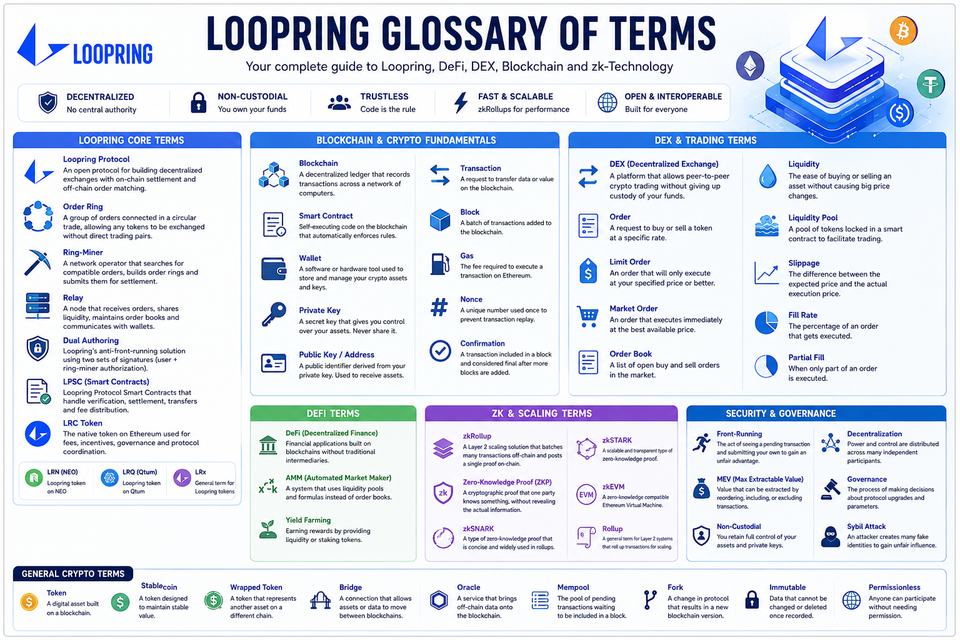
Blockchain • Crypto • DeFi • Loopring • DEX • zk Technology
A
Account Abstraction
A smart-contract based wallet architecture that allows programmable wallet behavior like social recovery, batching, and gas abstraction.
Address
A public blockchain identifier used to send and receive assets.
Airdrop
Free distribution of tokens to users or communities.
AMM (Automated Market Maker)
A decentralized trading system using liquidity pools and formulas instead of traditional order books.
Arbitrage
Profiting from price differences between markets or exchanges.
Asset Tokenization
Converting real-world or digital assets into blockchain tokens.
Atomic Settlement
A transaction where either all parts execute successfully or none execute at all.
Auth Signature
A cryptographic authorization signature used in Loopring’s Dual Authoring system.
AuthAddr
A special address used in Loopring order authorization.
AuthKey
Temporary cryptographic keys used to secure order-rings.
B
Bear Market
A prolonged market downturn with falling asset prices.
Bid-Ask Spread
Difference between highest buy price and lowest sell price.
Bitcoin
Bitcoin the first decentralized cryptocurrency.
Block
A bundle of blockchain transactions grouped together.
Blockchain
A decentralized distributed ledger storing transactions securely across many computers.
Block Explorer
A tool used to inspect blockchain transactions, wallets, and smart contracts.
Block Producer
An entity responsible for creating new blockchain blocks.
Bridge
Infrastructure allowing assets or data to move between blockchains.
Burn
Permanent destruction of tokens.
Burn Rate
Percentage of fees converted into and burned as LRC.
Bull Market
A prolonged market uptrend with rising asset prices.
Byzantine Fault Tolerance
A system’s ability to function even when some participants act maliciously.
C
Centralized Exchange (CEX)
An exchange controlled by a company that holds user assets.
Chain
Another term for blockchain network.
Cold Wallet
A wallet stored offline for security.
Consensus
The method blockchain networks use to agree on valid transactions.
Consortium Blockchain
A shared blockchain used between trusted parties.
Cross-Chain
Interactions occurring between different blockchains.
Cryptography
Mathematical techniques used to secure blockchain systems.
Custody
Control over assets or private keys.
D
DAO (Decentralized Autonomous Organization)
A blockchain-based organization governed by smart contracts and token holders.
Decentralization
Distribution of power, control, infrastructure, or governance across many participants instead of one central authority.
Decentralized Exchange (DEX)
A crypto exchange where users trade directly from their wallets.
DeFi (Decentralized Finance)
Financial applications built on blockchains without traditional intermediaries.
Derivatives
Financial products deriving value from underlying assets.
Digital Signature
Cryptographic proof that verifies ownership or authorization.
Distributed Ledger
A database shared across many computers.
Double Spend
Attempting to spend the same digital asset twice.
Dual Authoring
Loopring’s anti-front-running signature system.
dApp
A decentralized application running on blockchain infrastructure.
E
ERC20
Ethereum token standard for fungible assets. Ethereum
Ethereum
Ethereum blockchain platform supporting smart contracts and decentralized applications.
Execution Layer
The blockchain layer processing transactions and smart contracts.
F
Fiat Currency
Government-issued money like USD or EUR.
Fill Rate
Percentage of an order successfully executed.
Flash Loan
An uncollateralized loan that must be repaid within one blockchain transaction.
Fork
A blockchain protocol change or network split.
Front-End
The user interface users interact with.
Front-Running
Manipulating transaction ordering to gain unfair trading advantage.
Full Node
A computer storing and validating the complete blockchain history.
G
Gas
Fee paid to execute blockchain transactions.
Gas Abstraction
A system allowing users to pay fees differently or indirectly.
Genesis Block
The first block of a blockchain.
Governance
Decision-making processes controlling protocol upgrades and policies.
Governance Token
A token granting voting rights within a protocol.
Gwei
Small denomination of ETH used for gas pricing.
H
Hard Fork
A non-backward-compatible blockchain upgrade.
Hash
A cryptographic output uniquely representing data.
Hashrate
Computational power securing proof-of-work networks.
Hot Wallet
An internet-connected cryptocurrency wallet.
Hybrid Exchange
An exchange combining off-chain and on-chain systems.
I
Immutable
Unable to be altered after confirmation.
Impermanent Loss
Temporary value loss liquidity providers experience due to price movement.
Interoperability
Ability for systems or blockchains to communicate together.
IOU
A promise representing assets held by another entity.
K
Key Pair
A cryptographic private/public key combination.
KYC (Know Your Customer)
Identity verification procedures required by some platforms.
L
Layer 1 (L1)
Base blockchain layer like Ethereum or Bitcoin.
Layer 2 (L2)
Scaling systems built on top of Layer 1 blockchains.
Limit Order
An order specifying a required price or exchange rate.
Liquidity
How easily assets can be traded without major price movement.
Liquidity Mining
Rewarding users for providing liquidity.
Liquidity Pool
Shared pool of assets used for decentralized trading.
Liquidity Sharing
Sharing orders or liquidity across relays or exchanges.
Loopring
Loopring decentralized exchange protocol focused on zkRollup scaling and order-ring matching.
LPSC (Loopring Protocol Smart Contracts)
Core Loopring settlement and verification contracts.
LRC
Loopring Ethereum-based Loopring ecosystem token.
LRN
Loopring token planned for the NEO blockchain.
LRQ
Loopring token planned for the Qtum blockchain.
LRx
General naming convention for Loopring ecosystem tokens.
M
Margin Split
Price improvement shared between traders and ring-miners.
Market Maker
A participant providing market liquidity.
MEV (Maximal Extractable Value)
Profit validators or bots extract by manipulating transaction ordering.
Mempool
Pool of pending blockchain transactions.
Merkle Tree
A cryptographic data structure used for efficient blockchain verification.
Miner
Entity validating and producing blocks in proof-of-work systems.
Mining
Process of validating blockchain transactions.
Modular Protocol
A protocol designed with interchangeable components.
N
Network Effects
Value increase as more participants join a system.
Node
A computer participating in a blockchain network.
Non-Custodial
Users maintain control of their own assets.
Nonce
Unique value preventing duplicate transaction execution.
O
Off-Chain
Processes occurring outside the blockchain.
On-Chain
Processes occurring directly on blockchain infrastructure.
Open Source
Software with publicly accessible code.
Oracle
A service bringing external data onto a blockchain.
Order Book
List of active buy and sell orders.
Order Matching
Connecting compatible trades.
Order Ring
Loopring’s circular trade structure connecting multiple orders.
Order Scaling
Reducing order sizes proportionally if balances are insufficient.
OTC (Over-the-Counter)
Direct trading outside traditional public exchange order books.
P
Pair Trading
Traditional two-asset trading.
Permissionless
A system requiring no approval to participate.
Private Key
Secret cryptographic key controlling assets.
Proof of Stake (PoS)
Consensus mechanism based on token staking.
Proof of Work (PoW)
Consensus mechanism based on computational work.
Protocol
A standardized set of rules governing systems.
Public Key
Public cryptographic identifier derived from a private key.
Q
Qtum
Qtum blockchain platform associated with LRQ.
Quantum Resistance
Protection against attacks from quantum computing.
R
Rate Discount
Improved pricing created through efficient ring matching.
Relay
Loopring network node handling orders and liquidity.
Relay-Mesh
Loopring relay communication network.
Ring Settlement
Final execution of an order-ring.
Ring-Miner
Loopring operator assembling and submitting order-rings.
Rollup
Layer 2 scaling system batching transactions together.
Rug Pull
A scam where project operators abandon a project and steal liquidity.
S
Scalability
Ability for a blockchain to handle increasing usage.
Settlement
Final completion of a trade.
Sharding
Splitting blockchain data processing across multiple segments.
Signature
Cryptographic proof of authorization.
Slippage
Price movement during trade execution.
Smart Contract
Self-executing blockchain code.
Solidity
Ethereum smart contract programming language.
Stablecoin
A token designed to maintain stable value relative to another asset.
Staking
Locking tokens to support network security or governance.
Sub-Ring
A hidden smaller loop inside an order-ring prohibited by Loopring.
Sybil Attack
Attack using many fake identities to manipulate systems.
T
Token
A blockchain-based digital asset.
Token Burn
Permanent removal of tokens from circulation.
Tokenomics
Economic design and incentives behind a token system.
TPS (Transactions Per Second)
Measurement of blockchain throughput.
Trade Settlement
Final transfer of assets between parties.
Trustless
A system not requiring trust in intermediaries.
U
UDOM (Unidirectional Order Model)
Loopring’s order structure using amountS and amountB instead of bids and asks.
Upgradeability
Ability for protocols to evolve over time.
V
Validator
A participant validating blockchain transactions.
Volatility
Degree of price fluctuation.
W
Wallet
Software or hardware used to manage crypto assets.
Wallet Fee Sharing
Loopring system where wallets receive part of trading fees.
Web3
A decentralized internet ecosystem built on blockchains.
Wrapped Token
A blockchain token representing another asset.
Z
Zero-Knowledge Proof (ZKP)
A cryptographic proof showing something is true without revealing underlying information.
zkEVM
A zero-knowledge compatible Ethereum Virtual Machine.
zkProof
Compressed cryptographic proof used in zero-knowledge systems.
zkRollup
A Layer 2 scaling technology batching transactions into cryptographic proofs for faster and cheaper Ethereum transactions.
zkSNARK
A specific type of zero-knowledge proof system.
zkSTARK
A scalable and transparent type of zero-knowledge proof system.